
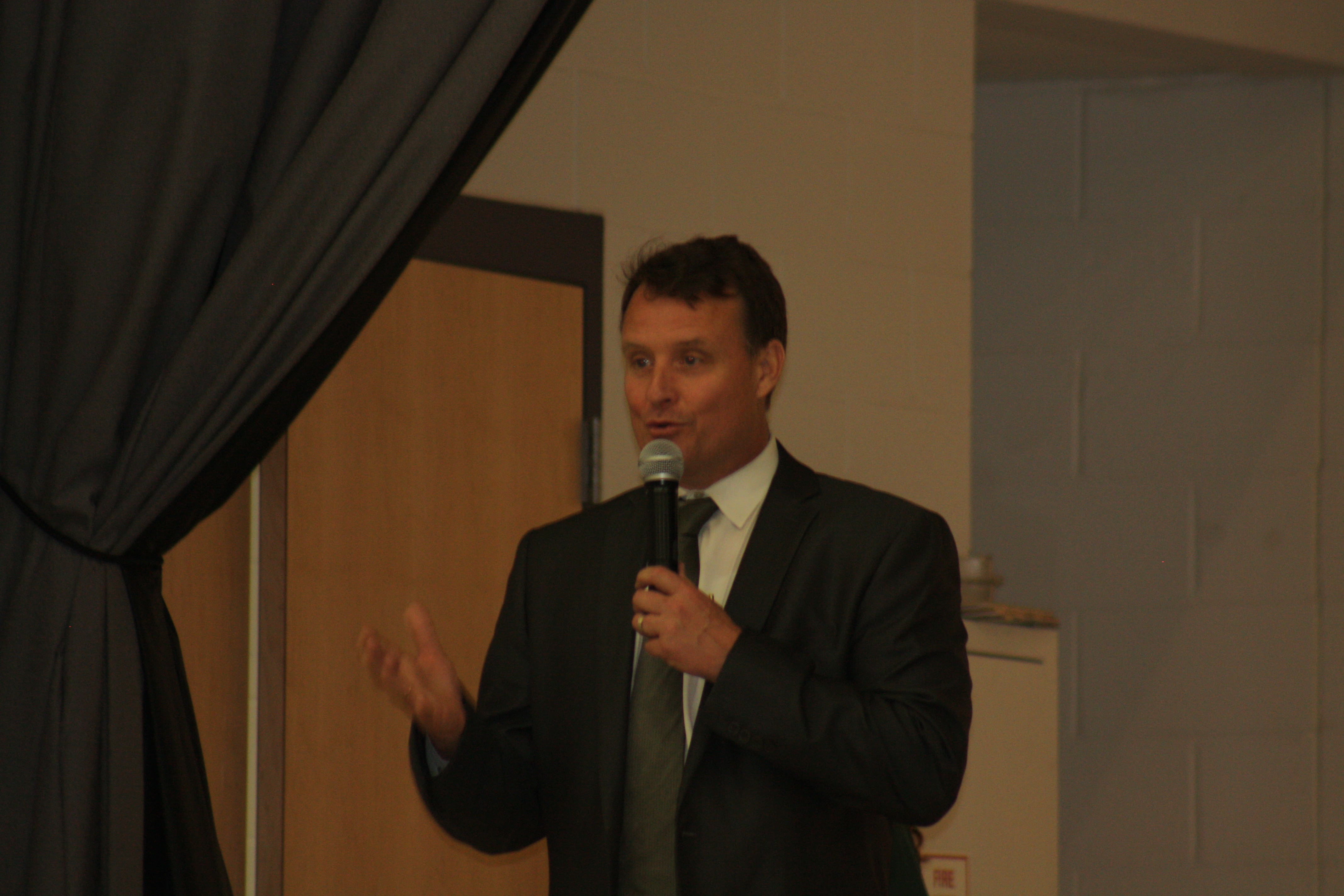
 by State Senator Michael O. Moore
Recently, President Barack Obama discussed the importance of the federal government ensuring college affordability, an initiative that Massachusetts has already taken the lead on. As the Senate Chairman of the Joint Committee on Higher Education, I feel it is important for Massachusetts to promote ways to make higher education more affordable and accessible to students. There is a direct correlation between the amount of state funding allocated to public higher education in the state budget and the tuition and fees that the institutions charge their students.
As a result of the economic downturn, funding for public higher education has seen dramatic cuts over the past decade. Our state spending on higher education, which includes funding for the UMass system, community colleges and state universities, declined 31% from FY 2001 to FY 2013. While state funding decreased, the needs of these institutions increased with more students turning to public higher education options since they were an inexpensive option. To make up for the budget shortfall, public institutions have consistently raised the price of student tuition and fees.
Starting with this year’s state budget, we are working to reverse this trend. Due to an increased investment in the state budget for each segment of our higher education system, all public higher education campuses agreed to freeze tuition and fees for the upcoming year. This year’s fiscal budget also included over $90 million in scholarship funding, $3,674,842 to fund the state’s obligation to provide a no cost public higher education for foster and adopted children, and $4 million for Tufts University’s Cummings School of Veterinary Medicine in Grafton, New England’s only veterinary school.
There is also a focus on holding our public higher education institutions accountable for student success. This year, a performance-based funding system was implemented for community colleges. For the first time, half of each college’s budget will be tied to its ability to improve graduation rates and meet the state’s workforce needs. To start, every community college will get an operating subsidy of $4.5 million. Then, 50% of the remaining allocation will be distributed based on student credit hours completed, weighted for the cost of teaching in different fields. The other 50% of the remaining funding will be based on performance, including the numbers of students who earn degrees or certificates, or transfer with a certain number of credits. There is also extra credit for training students for degrees in high-demand fields including science, health care, and technology, and also for the successes of low-income students. This plan of 50% performance-based funding makes our state’s initiative one of the most ambitious in the country. In other states, just 5 to 10 percent of respective higher education budgets are being tied to performance.
While the Higher Education Committee works on ways to help control the costs and to hold schools accountable for student success, the unfortunate reality is that more and more students are graduating with a significant amount of debt. Article after article highlights the serious difficulties that students are having paying off the large amount of student debt they incur while in school. Equally troubling is that while more and more students are enrolling in college, many are dropping out without completing a degree. In these cases, the former student has incurred debt, yet they will not benefit from the better job prospects that they would have received with a degree.
I think more can and should be done to ensure that students and parents are fully aware of the costs involved in financing a college education. With more financial literacy, potential students can be made aware of the full costs of their education and what their financial responsibilities will be upon graduation. Many of the students I have talked to wished they were better informed in high school about the higher education options available to them, such as starting at a lower-priced community college, which would help them lower their student debt.
The financial aid system, which consists of federal, state and private loans, plays an important role in keeping the cost of college affordable. Aid and loans are allocated mainly based on need, but there are some merit based programs as well as those that focus on training students to work in high-need fields. The Department of Higher Education establishes the regulations for the state financial aid programs. Information on the state programs may be found at http://www.osfa.mass.edu.
While state financial aid is only a small piece of the financial aid puzzle, we always want to ensure that our limited state resources are being used in the most effective way. To this end, we want to make sure that financial aid is not being used to allow colleges to raise their tuitions simply because more financial aid is available to students. Since financial aid is such an important issue to so many of our constituents, a Subcommittee on Student Debt was formed in order to do an overview on what types of aid/loans are offered and if they are working to accomplish what they set out to do which is to keep students in school and debt down. The subcommittee will also look at other issues, such as loan forgiveness opportunities, standardization of state schools accepting AP credits, the effectiveness of UPlan 529 and what other states are doing to keep costs down while offering a quality education.
It is time for the Commonwealth to continue to lead the nation in making our public higher education system more affordable and accessible by pushing for continued efficiencies, holding schools accountable for student success and ensuring that financial aid/loans are used most effectively. Our students should not have to risk disproportionate debt, simply for having the desire to improve their lives through a college education.

 UPTON DAILY