

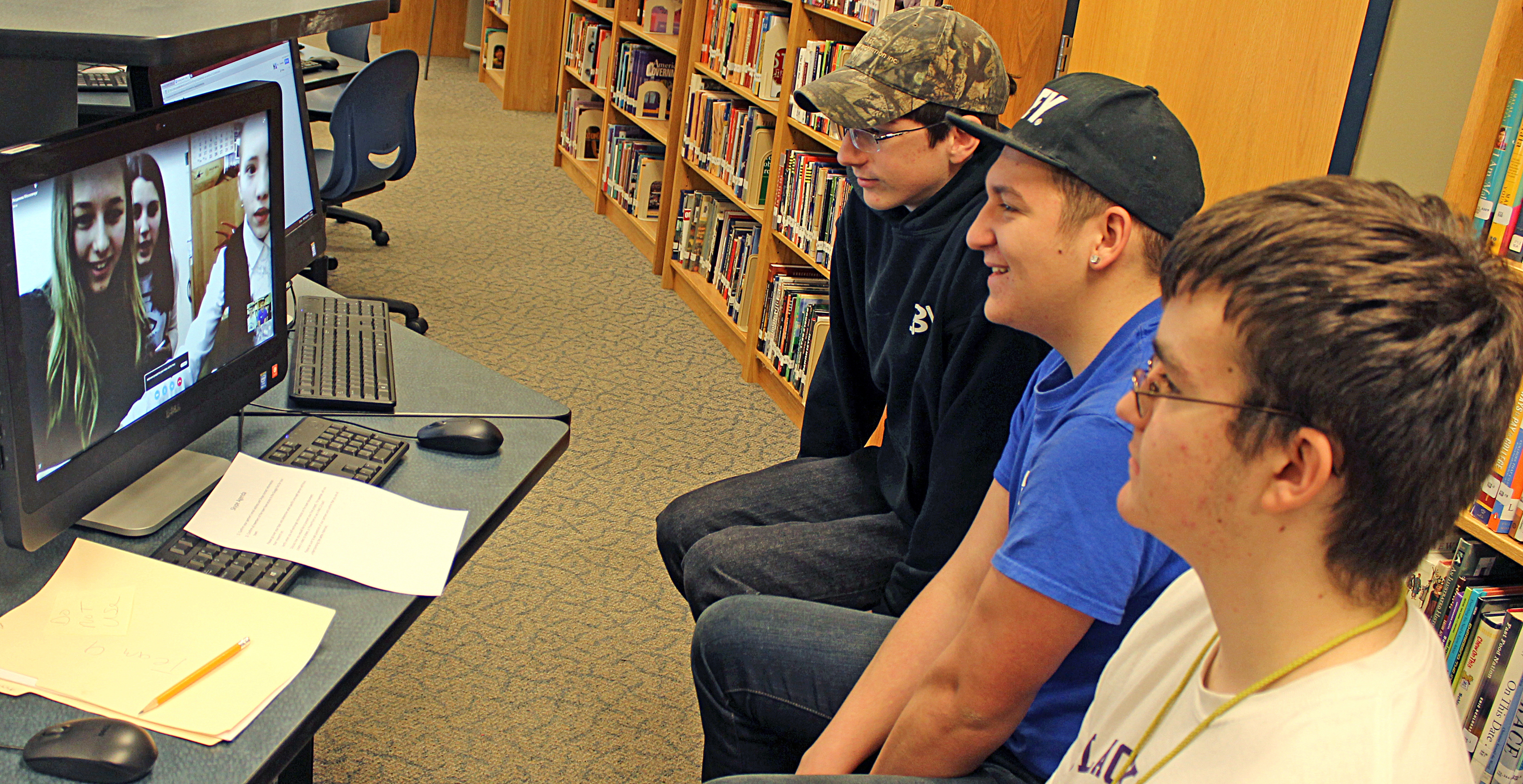
In addition to collaboratively studying scientific principles, Valley Tech Plumbing sophomores (left to right) Alex Davieau of Northbridge, Andrew Porter of Hopedale, Peter Wood of Sutton and their Russian partners discuss their respective cultures, including favorite forms of entertainment and recreation.
UPTON – It might be quite the hike and a bit of a swim from one school to the other, but students at Blackstone Valley Tech in Upton, MA are nonetheless teaming up with students in Arkhangelsk, Russia to prove that great distance is not a barrier to great collaboration.
The intercontinental partnership was formed last year when Valley Tech teamed up with the Global STEM (Science, Technology, Engineering, Mathematics) Education Center, a 501(c)(3) charitable organization that partners schools with other countries, corporations, scientists, and engineers to develop and participate in STEM projects. Working with Valley Tech Director of Technology Donna Sroka, Global STEM Education Center founder Larisa Schelkin developed a project in which BVT Electrical students and their Russian counterparts jointly studied the science of physics within vocational technical training in electrical engineering.
“It doesn’t matter where you are going to work, or what your specialty might be, you have to have 21st century skills,” explained Schelkin. “And the number one skill is the ability to work collaboratively in a multicultural environment. That is what this project is about; collaboration, communication, teamwork, trouble shooting, logical thinking. It’s the whole package of 21st century skills.”
Using telecommunications programs such as Skype and Google Docs, seven teams consisting of at least two students from each school collaborated on projects comparing domestic electrical wiring, green energies, and electrical production in the United States and Russia. When the teams shared their final projects last May, Daniel Bissonnette of Blackstone was among several proud parents in attendance.
“I thought it was interesting,” Bissonnette said. “There’s no doubt this is going to help them communicate throughout the country or the world.”
Building on last year’s successful pilot program, Valley Tech expanded the Global STEM project this year to include the Electrical, Culinary Arts, and Plumbing departments. American and Russian students are currently exploring each vocational program’s curriculum as it relates to the International Space Station, including scientific principles and theorem such as the electronic structure of the atom, the viscosity of liquids, and thermodynamics.
While working with his Russian partners during a recent session, Plumbing sophomore Daniel Aldonis of Millbury said that because of their countries’ respective climates, the U.S. students and Russian students brought different ideas to the table concerning methods of recycling water. Learning about another culture’s approach to plumbing, according to Aldonis, has made him take a fresh look at his own vocational training.
“It’s unique that we get to see a Russian perspective on what we are doing in shop,” Aldonis said. “It really makes you think about how you might have to do things differently if you ever end up working in Russia.”
As the second successful year of the project unfolds, Valley Tech Superintendent-Director Dr. Michael Fitzpatrick envisions the global collaboration becoming a system-wide project for years to come.
“The Global STEM project is a shining example of our integrated approach to academics and vocational technical training,” Fitzpatrick said. “The innovative instructional techniques foster new levels of learning enthusiasm coupled with diverse cultural awareness opportunities. The long-term benefits of our partnership will be most evident in the 21st century work skills of our graduates.”
More information on the Global STEM Education Center is available online: www.globalSTEMcenter.org

 UPTON DAILY