
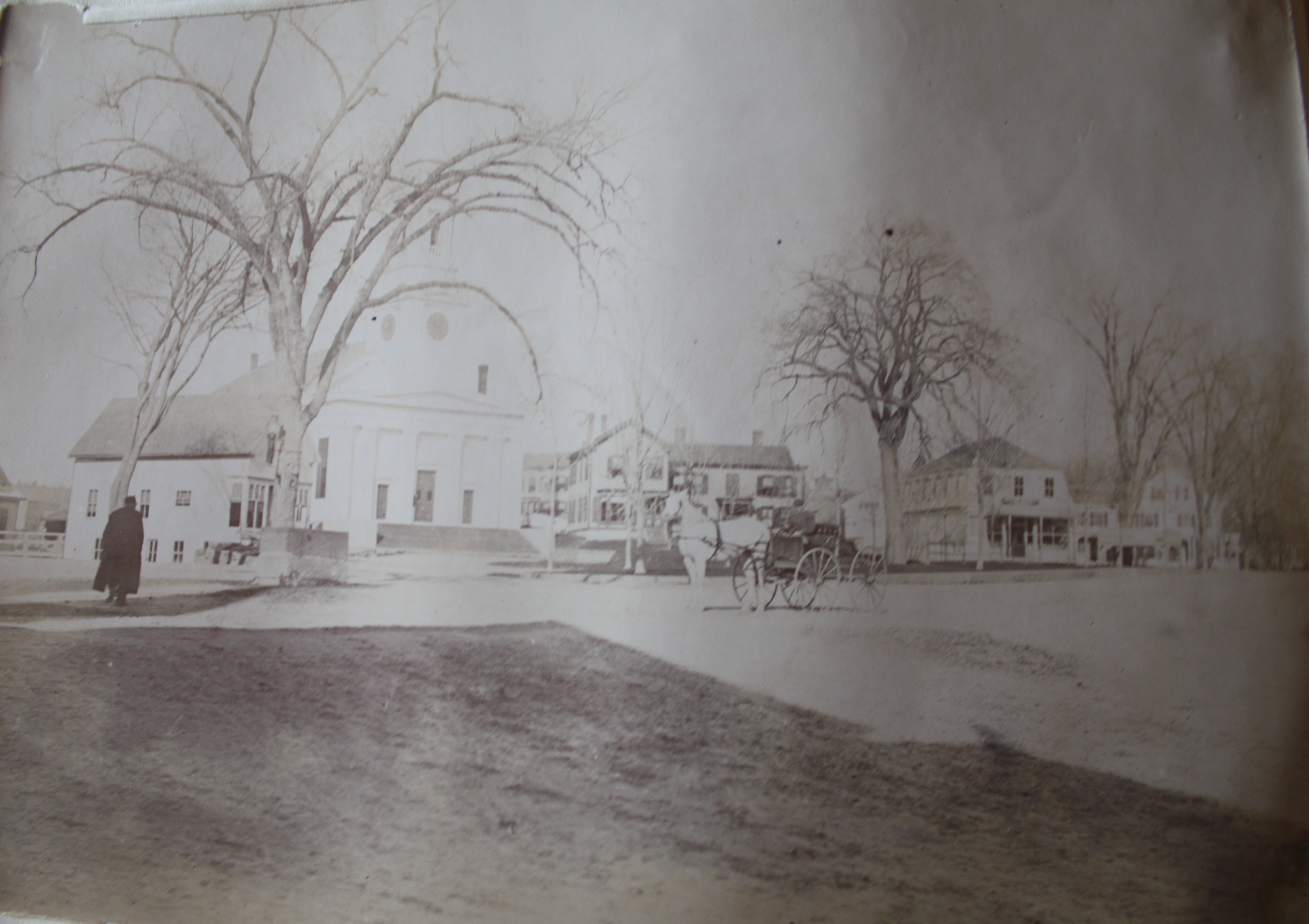

submitted by the Upton Historical Commission
In January 2015 the Upton Historical Commission (UHC) received word that the Upton Center Historical District was accepted to the National Register of Historic Places. (NRHP). This process was made possible from Community Preservation Act funding approved in 2008 in a Town Meeting.
The Upton Center Historical District is significant for its association with the development of Upton’s civic and social history and for its architecture, which spans two centuries and exhibits regional patterns of architectural ornamentation. The Upton Center District, which radiates from the town common, is intact and collectively retains integrity of location, design, setting, materials, craftsmanship, feeling and association. The district is significant at the local level for a period extending from the earliest construction date of the mid-18th century to 1962, through which time Upton Center evolved into Upton’s civic center with modest commercial activity and residential neighborhoods of 19th and early 20th century houses. Architecture in Upton Center displays predominately Federal, Greek Revival, and Italianate styles with smatterings of picturesque styles like Queen Anne, East Lake and Victorian Gothic.
The town common, established in the late 18th century forms the nucleus of Upton’s civic center. The oldest home in the center of Upton is the Wood House, and the oldest commercial building in the center is at 2 Grove Street. In the 1800s the town common was much larger and included a sturdy elm tree called the “Parson Elm” where the Rev. Benjamin Wood was ordained in 1796. The Upton House of Pizza was once Upton’s first drug store, and a gristmill was located on Center Brook. The old post office was located in a dry goods store that now is the location of Sheer Excitement and the Never Mind Shop.
Recognition of Upton Center as a historic district connects our present time to our past culture and history. A listing of this Historic District provides recognition and assists in preserving our nation’s heritage. The listing recognizes that the area is important to the history of the community, state, and nation. It allows the owners of income-producing properties certain federal tax incentives for rehabilitation, and provides limited protection from adverse effects by federal or state-involved projects.
The Upton Center Historic District represents Upton’s architectural and cultural history. Its built environment is a record of how the lives and livelihoods of the neighborhood’s residents have changed through two centuries, from a society based largely on agriculture to a self-contained industrial village to today’s community of commuters earning their livelihoods outside of town. There are 148 contributing features including buildings, objects, sites, and structures.

 UPTON DAILY
How would you like to cross that intersection at night to attend a Town Hall event???
Never should have bought the building in the first place. Knee jerk reaction to justify the $7.7 mil wasted on the Town Hall.
Seriously, how often do we need more than the available parking on 140 and on the side street in those few spots for people doing business at the town hall?
The only times I recall being there with parking any sort of issue, meaning a long walk down 140 on the sidewalk) was for pinewood derby events. Even when my children played basketball there we didn’t park far from the building.
I think if you want to save the property it is a good idea. But don’t just let it sit there & rot because it’s historical, make it look like it was when it was first built, bring it back to life so people can enjoy it more than looking at a pile of falling debris! Just my thought 🙂
Cathy of the historical commission said, “Upton passed a demolition delay law in 2005 after the stone silo on Grove Street was demolished. This town bylaw is on the town website and has a possible 12-month delay for discussion of historic preservation.”
Which means that the building is not automatically protected by the National Register designation. The National Register is more of an honorary thing. It says the town takes pride in its historic character. It is useful if a property owner wants government grants for renovations and tends to raise the value of the homes in the area. That is all.
If an owner decides to take down a building that is greater than 74 years old, it falls under the demolition delay bylaw mentioned by Cathy and Jennifer. That is the only protection 2 Grove St has. The demolition delay is 12 months, in which time the Historical Commission would, if it deems the property to be of value historically, try to work with the property owner to see if something can be done to avoid demolition.
I personally do not think the property should be torn down. It is the oldest, still standing, commercial building in the new historic district. In addition, that lot doesn’t make for the safest parking area in my opinion. Anyone going to the Town Hall has to cross 2 dangerous streets without any traffic lights.
So does this mean the town will be unable to tear down 2 Grove Street for parking?